
Magellan's Cross Cebu
Ferdinand Magellan was the first European to come to the Philippines in 1521. Also known as Fernao Magalhaes or Fernando Magallanes, he was a Portuguese navigator working for the King of Spain in search of the spice islands (now part of Indonesia, known as Maluku or Moluccas islands). When he and his crews landed on Cebu island, a native chief, Rajah Humabon, met and befriended him. Rajah Humabon, his wife and hundreds of his native warriors agreed to accept Christianity and were consequently baptized.
Magellan planted a cross to signify this important event about the propagation of the Roman Catholic faith in what is now Cebu, in central Philippines. The original cross is reputedly encased in another wooden cross for protection, as people started chipping it away in the belief that it had miraculous healing powers. This prompted the government officials to encase it in tindalo wood and secured it inside a small chapel called "kiosk." Some say, however, that the original cross was actually destroyed. The Magellan cross displayed here is said to be a replica of such cross. It is housed in a small chapel located in front of the present city hall of Cebu, along Magallanes Street (named in honor of Magellan).
Sadly, Magellan met his death under the hands of another Visayan chief, Lapu-Lapu, when he went to the nearby island of Mactan. Mactan is also part of today's Metropolitan Cebu. There, both the statues of Magellan and Lapu-Lapu proudly stand to commemorate the tragic meeting of east and west in this part of the world.
It took another 45 years (1565) before Cebu was visited again by another European. Miguel Lopez de Legazpi, under orders from King Philip of Spain, came and made Cebu the first capital of the Spanish colony known as Las Islas Filipinas

Basilica del Santo Nino Cebu
The Minor Basilica of the Holy Child (Cebuano: Basilica Menore del Santo Niño Spanish:Basilica del Santo Niño and Filipino: Basilica Menor del Santo Niño) and commonly known as theSanto Niño Basilica, is a minor basilica in Cebu City in the Philippines that was founded in the 1565. It is the oldest Roman Catholic church established in the country on the spot where the image of the Santo Niño de Cebú, a statue depicting the Child Jesus was found in 1565 by Spanish explorers led by Miguel Lopez de Legazpi. The Holy See calls the temple the "Mother and Head of all Churches in the Philippines" (mater et caput... omnium ecclesiarum Insularum Philippinarum).[3]The image is the same statue given by Ferdinand Magellan to the wife of Rajah Humabon as a gift over forty years after Humabon's baptism to Christianity on April 14, 1521. It was found by a soldier preserved in a burnt wooden box after Legazpi razed the village of hostile natives.[1] When Pope Paul VI made the church a basilica in 1965, he said it was "the symbol of the birth and growth of Christianity in the Philippines."[4]

Cebu Metropolitan Cathedral
The Cebu Metropolitan Cathedral, also as The Metropolitan Cathedral of the Most Holy Name of Jesus and of St. Vitales (consecrated to the blessed name of Jesus and dedicated to the saint), or The Metropolitan Cathedral of St. Vitales[1] is the ecclesiastical seat of the Metropolitan Archdiocese of Cebu in Cebu, Philippines.[2] Cebu was established as a diocese on August 14, 1595. It was elevated as a metropolitan archdiocese on April 28, 1934 with the dioceses of Dumaguete, Maasin, Tagbilaran, and Talibon as suffragans. Before being raised as a primatial church in Cebu, the temple was one of the first churches in the Philippines (besides the Basilica del Santo Niño) dedicated to St. Vitales and built near the fort in April of 1565 by Miguel Lopez de Legazpi and Fray Andrés de Urdaneta.[3]
The architecture of the church is typical of Spanish colonial churches in the country, namely, squat and with thick walls to withstand typhoons and other natural calamities. The facade features a trefoil-shaped pediment, which is decorated with carved relieves of floral motifs, an IHS inscription and a pair of griffins. The Spanish Royal Coat of Arms is emblazoned in low relief above the main entrance, reflecting perhaps the contribution of the Spanish monarch to its construction.
During World War II, much of the cathedral was destroyed by Allied bombings of the city. Only the belfry (built in 1835), the façade, and the walls remained. It was quickly rebuilt in the 1950s under the supervision of architect Jose Ma. Zaragosa,[5] during the incumbency of Archbishop Gabriel Reyes.
In 1982, a mausoleum was built at the back of the sacristy at the initiation of Archbishop Julio Cardinal Rosales.[6] It serves as a final resting place for the remains of Cebu's bishops and clergy. Cardinal Rosales, who died three months after inauguration of the mausoleum, is interred there along with Archbishop Manuel Salvador, a coadjutor archbishop of Cebu, and Archbishop Mariano Gaviola, the archbishop of Lipa (1981–1993). The remains of Bishop Juan Bautista Gorordo, the first Filipino and Cebuano bishop of Cebu, are also interred there.
The cathedral was renovated for the 75th anniversary celebration on April 28, 2009 of the elevation of Cebu into an archdiocese.[7] An application is pending at the Vatican for the cathedral's elevation into a minor basilica[8] in honor of St. Vitalis, an early Christian martyr. His feast day coincides with the day the image of the Sto. Niño de Cebu was found almost 450 years ago, as well as the anniversary of the elevation of Cebu into an archdiocese

Casa Gorordo Cebu
The Casa Gorordo Museum is a 19th century lifestyle museum and the centerpiece project of the Cultural Heritage Program of the Ramon Aboitiz Foundation, Inc. The house itself was built in the 1850's and originally owned by the Alejandro Reynes y Rosales. It was bought by Juan Isidro Gorordo, a Spanish merchant, in 1863. Four generations of the Gorordo family have lived in this house including Bishop Juan Gorordo, the first Filipino bishop.
The girth of the structure is evidence by the massive stone walls in the lower portion of the house. Made of coral, there are good protection from the fire and typhoons. Huge posts of molave (tugas) extend from the basement to support the clay tile roof. Wide windows with sliding panels are fitted with translucent capiz shells.
After it was acquired by RAFI, the houes was firts renovated between 1980 and 1981. It was officially opened to the public on December 15,1983. In 2005, a major second renovation was undertaken to replace aging elements. In recognition of the historical and social significance of the house, the National Historical Institute (NHI) conferred on the Casa Gorordo Museum the title "National Landmark" in 1991.
The Ramon Aboitiz Foundation, Inc. (RAFI) was established in 1966. Beginning purely as a charitable institution, it grew and developed programs which aimed to improve lives in various sectors of society. The Cultural Heritage Program of RAFI seeks to conserve, preserve, document and develop the Cebuano cultural heritage as a source for Cebuano social history, and identify and tap these heritage resources for the benefit of the community.

Taoist Temple Cebu
Built in 1972, the Cebu Taoist Temple is located in Beverly Hills Subdivision in Cebu City, Philippines. The temple was built by Cebu's substantial Chinese community.[1] With an elevation of 300 metres (980 ft) above sea level, the temple is a towering, multi-tiered, multi-hued attraction accessible by three separate winding routes.
Unlike the neighboring Phu Sian Temple,[2] the Taoist temple is open to the worshipers and non-worshipers alike. A ritual among devotees is where one prays to the gods to grant one's wish. The ritual includes washing of hands, going inside the chapel barefoot and dropping two blocks of wood. If the blocks of wood are both face up then one could make a wish. If not then it is not yet the time for one's wish to be granted and one has to come to the temple some other time.
The temple is the center of worship for Taoism, the religion which follows the teachings of the ancient Chinese philosopher, Lao Zi. Another ritual among Taoist devotees, which is done during Wednesdays and Sundays,[3] is the climbing of its 81 steps (representing the 81 chapters of Taoism scriptures) to light joss sticks and have their fortune read by the monks.
Some guide books and travel agencies offer trips to the temple or as a side-trip in a tour around Cebu City. But it is more popular with grade school students.
The entrance to the temple was a replica of the Great Wall of China. The temple includes a chapel, a library, a souvenir shop and a wishing well. The spacious balconies offer a scenic view of the downtown Cebu.
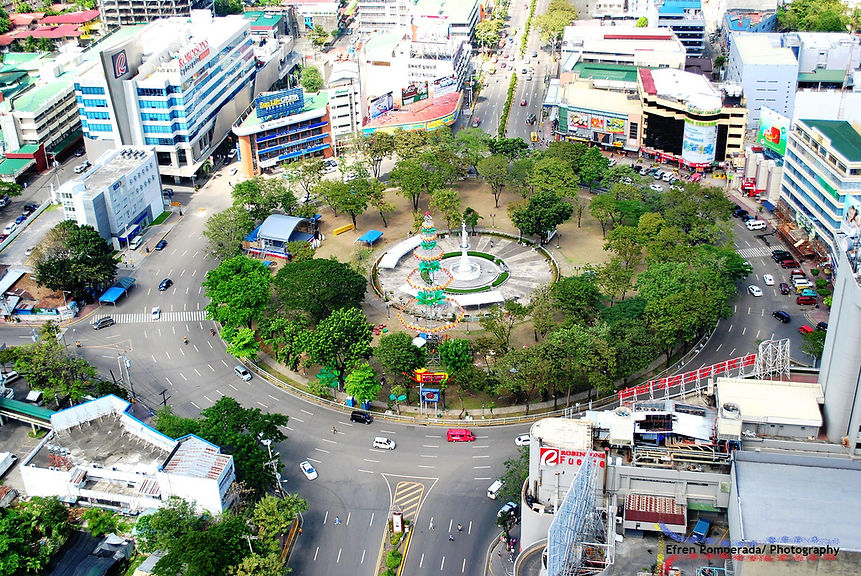
Fuente Osmena Circle Cebu City
Cebu's Fuente Osmeña is a fountain and a park located inside a rotunda along Jones Avenue and General Maxilom Avenue, Cebu City, Philippines. It is a great place where people gather to relax, exercise or just chat with friends. In addition, it is also where some special events are being held, such as beauty pageants, social events, governmental functions, among others.
In Honor of Osmena
It is built in honor of the late President Sergio Osmeña, the fourth president of the Republic of the Philippines. It has been inaugurated in 1912. It has been said that the fountain was built in inauguration of the City's new water system. Since then, it has evolved into a symbol of Cebuano's courage and pride. However, recent facts emerged regarding its original function.

Simala Shrine Sibonga Cebu
The sculpture of Miraculous Mother Mary at the Monastery of the Holy Eucharist is located at Marian Hills, Lindogon, Simala, Sibonga, Cebu, Philippines. The holy place is commonly known by locals as “Birhen Sa Simala Church”, filled with miraculous testimonials from devotees, believers and visitors who witnessed the event during the shedding of blood tears of Mother Mary’s image.
People from all walks of life within locals, other regions, and or from abroad, if you wish to have a tour/vacation in Cebu province — this must include on your list for places to visit in Cebu in the divine sanctuary of Mother Mary. There are living testimonials of the people whose prayers have been granted and answered. The appearance of the living proof having been displayed in the galleries in an ‘aparador’/glass closet – filled with tributes, letters/notes of achievements, granted prayers (about: employment, cured sick, working abroad and or board passers) from people whom have received the divine grace of Holy Mary. There are also different crutches and walkers (with letters), badges (with letters) existed and many more.
If you wish to give your donations, give it directly to the monks and not to anyone else. Aside from donations, there are several boxes displayed inside a certain area of monastery purposely for prayer requests, petitions and thanksgiving letters. Aside of those, a souvenir shop is also available inside the monastery that sells variety of rosaries, statues, prayer guides, and etc.

Kawasan Falls In Badian Cebu
Just 130 kilometers southwest of Cebu City and about three hours bus ride, the Kawasan Falls is located inside the mountains of Barangay Matutinao, Badian. From the entrance you will have to trek uphill for about thirty minutes, depending on your pace, to get to the first waterfall. Along the way, souvenir shops selling accessories such as beaded necklace, bracelets, and Kawasan print t-shirts are available for sale if you want to bring home souviners with you.
Kawasan has three waterfalls. The first one is mainly the largest of the three, and is usually the most crowded. An uphill climb for fifteen minutes will take you to the second falls, and another, to the third. You may bring in food, or buy from the resort's restaurants. Cottages and tables are also available for rent, as well as rooms for overnight stay. You may rent a raft to take you around the "pool" or for a refreshing "shower massage" under the falling water. Life vests are also available for a very affordable price.
The pathway may be very dark once the sun sets so its best to have a flashlight at hand. One should be extra careful in going down the slope especially those descending from the second or third falls to avoid mishaps or accidents.
Kawasan Falls is a popular get-away destination in the southern part of Cebu to locals and foreigners alike. With its lush tropical trees and plants everywhere, peaceful flow of the river as it gracefully rushes to the distant sea, the sound of the waterfalls on the background, friends and loved ones enjoying the cool and deep fresh water, everything around just seems so relaxed, simple and very serene.


Lambug Beach Badian Cebu
Lambug Beach Resort is a public beach located in Badian cebu. The area is still under-developed means no big hotels or resorts, But there are overnight cottages/villas are operating on the area.
Lambug Beach Resort has a long sand stretch and of course has crystal clear water. There are mini-stores and private cottages on the area....
Whale Shark in Oslob Cebu
Oslob is in Cebu province. Oslob is one of the two destinations in Philippines famous for Whale Shark watching. It is a tourist magnet and over a hundred thousand tourists come here every year to swim with the whale sharks. It is heavily criticizedthough, for feeding the whale sharks, and disrupting their natural migration patters and behaviours, thus falling under the category of irresponsible tourism.

Malapascua Beach Daan Bantayan Cebu
Malapascua Island is a Philippine island situated in the Visayan Sea, 6.8 kilometres (4.2 mi) across a shallow strait from the northernmost tip of Cebu Island. Administratively, it is part of the insular barangay of Logon, Daanbantayan, Cebu. Malapascua is a small island, only about 2.5 by 1 kilometre (1.55 by 0.62 mi), and has eight hamlets.
Malapascua became famous fairly recently, only in the early 1990s as a dive destination. Prior to this, the island was known for its wide white sand beach, known as Bounty Beach; it has also become known for its beautiful coral gardens, coral walls and excellent local dive spots, as well as further-out sites including Gato Island, Monad Shoal, and Kemod Shoal. Monad Shoal is an underwater plateau wherethresher sharks and manta rays can regularly be sighted.
Religiously, Malapascua Island or barangay Logon is believed to be the place where the Virgin de los Desamparados made a miracle sometime in 1890 when the island had only nine households of the Monteclar, Deogrades, Rosales, Gulfan, Rubio, Bohol and Bruces families. It was said to be a piece of wood that had never burnt. In 1907 the parish priest of Kandaya, now Daanbantayan town, Rev. Fr. Inocentes Maga,[1] baptized it of its name upon the request of the local residents. The size of the image is not the original size and it is said to be growing until present. Devotees from different parts of the country and even abroad come during the feast days on May 11 and 12. The chapel was originally made of coconut palm and leaves but now it is made of steel and cement.
Similar to other islands, natives were dependent on fishing as a source of livelihood. Agricultural products such as corn and rice were supplied from neighboring islands, such as Cebu and Leyte. With the population increasing and fish stocks dwindling, tourism came to the rescue. Nowadays, the majority of islanders either directly or indirectly make a living out of tourism, which is developing rapidly. The growth of tourism has also increased local immigration to the island, thus the demand for housing. The lack of a pier for bigger boats - due to financial constraints - is keeping a brake on construction growth.

Santa Fe Beach Daan Bantayan Cebu
Santa Fe is a fourth income class municipality on Bantayan Island in the province of Cebu,Philippines.[2] According to the 2010 census, it has a population of 27,270.[3] In the 2013 election, it had 14,933 registered voters.[4]
The municipality's territory occupies the south-eastern portion of Bantayan Island (marching with the municipality of Bantayan), together with the islands of Guintacan (or Kinatarkan),Hilantagaan and Hilantagaan Diot. Because the island's airport and principal ferry port are both located within the municipality, Santa Fe is considered the gateway to Bantayan and its islands.

Chocolate Hills Bohol
The Chocolate Hills (Filipino: Tsokolateng Burol) are a geological formation in the Bohol province of the Philippines.[1] There are at least 1,260 hills but there may be as many as 1,776 hills spread over an area of more than 50 square kilometres (20 sq mi).[2] They are covered in green grass that turns brown (like chocolate) during the dry season, hence the name.
The Chocolate Hills are a famous tourist attraction of Bohol. They are featured in the provincial flagand seal to symbolize the abundance of natural attractions in the province.[3] They are in the Philippine Tourism Authority's list of tourist destinations in the Philippines;[4] they have been declared the country's third National Geological Monument and proposed for inclusion in theUNESCO World Heritage List.[4]
The Chocolate Hills form a rolling terrain of haycock hills – mounds of a generally conical and almost symmetrical shape.[5] Estimated to be from 1,268 to about 1,776 individual mounds, these cone-shaped or dome-shaped hills are actually made of grass-covered limestone. The domes vary in sizes from 30 to 50 metres (98 to 164 ft) high with the largest being 120 metres (390 ft) in height. Bohol's "main attraction", these unique mound-shaped hills are scattered by the hundreds throughout the towns of Carmen, Batuan and Sagbayan in Bohol.[6]
During the dry season, the grass-covered hills dry up and turn chocolate brown. This transforms the area into seemingly endless rows of "chocolate kisses". The branded confection is the inspiration behind the name, Chocolate Hills.[4]

Tarsiers in Bohol
The Philippine tarsier (Carlito syrichta), known locally as mawmag in Cebuano/Visayans and mamag inLuzon, is a species of tarsier endemic to the Philippines. It is found in the southeastern part of the archipelago, particularly on the islands of Bohol, Samar, Leyte and Mindanao. It is a member of the approximately 45-million-year-old family Tarsiidae,[3] whose name is derived from its elongated "tarsus" or ankle bone.[4] Formerly a member of the genus Tarsius,[5] it is now listed as the only member of the genus Carlito, a new genus named after the conservationist Carlito Pizarras.[5][6]
Its geographic range also includes Maripipi Island, Siargao Island, Basilan Island and Dinagat Island.[2]Tarsiers have also been reported in Sarangani, although they may be different subspecies.
It was introduced to Western biologists during the 18th century.[7]
The Philippine tarsier measures only about 85 to 160 mm (3.35 to 6.30 in) in height, making it one of the smallest primates. The small size makes it difficult to spot. The mass for males is between 80–160 g (2.8–5.6 oz), usually lighter for females, somewhat heavier than other tarsiers such as the pygmy tarsier.[8]The average adult is about the size of a human fist.

Boracay Beach Panay Aklan
Boracay is a tropical island surrounded by stunning white sand beaches and clear blue waters located about an hour's flight from Cebu or Manila just off the larger Philippines island of Panay.
For beach connoisseurs, Boracay competes with the best beaches in more popular destinations such as the Caribbean and the South Pacific as well as neighboring Thailand, Malaysia and Indonesia. For those wanting to just lounge around and top up their tan, beachfront hotels usually have lounge chairs set up just a few steps away from the hotel entrances. The more active will appreciate water sports and activities such as sailing, windsurfing, snorkeling, diving and jet skiing. The fun in Boracay doesn't end when the sun sets. The nightlife pulsates with many bars and restaurants serving food, drink and fun until the wee hours of dawn.
In terms of hotel prices, Boracay has very distinct seasons. There are two main seasons, low and high, and within high season there are three peak seasons. Low season if from June 1-November 1 or December 1 depending on the hotel. High season is usually from Nov 1, or Dec 1, to May 31. Usually hotels charge about about 30% more in high season over low season.
The peak seasons are roughly as follows:
1. Christmas/New Year Dec 15-Jan 5
2. Chinese New Year: Date of Chinese New Year +/- 3 days. i.e. if Chinese New Year falls on Febr. 8, prices will increase Febr. 5-Febr. 11.
3. Easter: Date of Easter Sunday -4 days and +2 days. i.e. if Easter Sunday falls on March 27, hotels will be more expensive March 23-March 29.
For peak season prices will increase an additional 20-30% on top of high season prices.
Prices are negotiable at any time of year, though for peak season a lot of places get fully booked, so negotiating with the places still available will be much more difficult.

El Nido Palawan
The beauty of El Nido is almost surreal: Endless white beaches, crystal clear waters and an underwater world, that will take your breath away. A destination that truly looks like paradise.